




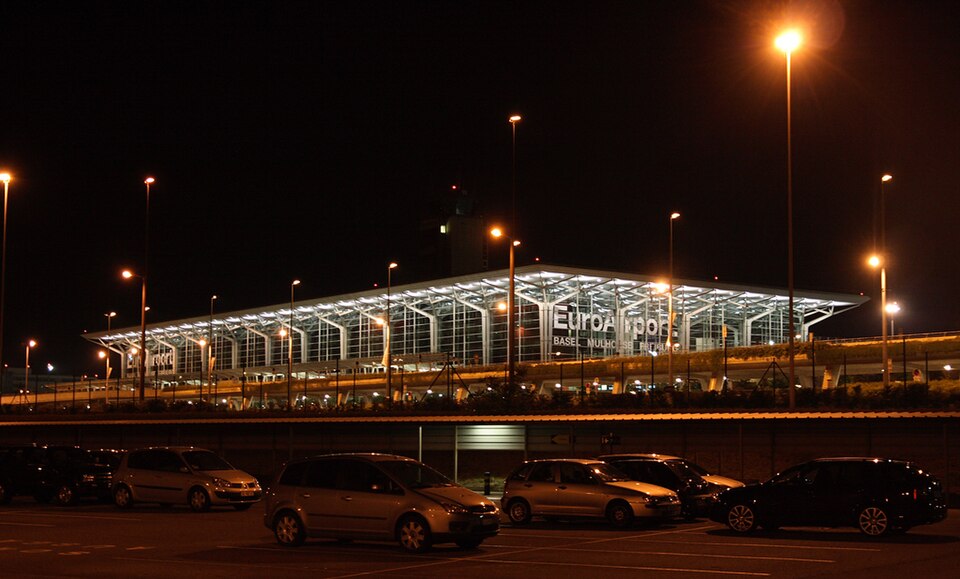
With 7.3 million travelers in 2016, EuroAirport occupies a strategic place in the transport system of Upper Rhine : third Swiss airport and fifth French airport outside Île-de-France.
Located on French territory, in the agglomeration of Basel/Saint-Louis, the airport is distinguished by a binational governance and an extended cross-border area of influence, covering a large part of the cooperation area Interreg Upper Rhine.
Despite the immediate proximity of the railway line Mulhouse — Basel, the airport's ground service is now almost exclusively based on the Road mode.
In this context, SNCF Réseau wishes to study the feasibility and relevance of a direct rail service, provided by French and Swiss regional trains, based on:
Explain is responsible for driving thecomprehensive socio-economic assessment of the project.
The mission starts with a thorough territorial diagnosis, highlighting the advantages, constraints and dysfunctions of the current service, and making it possible to characterize mobility needs at the cross-border level.
The analysis compares a reference option and several project options, based on:
The socio-economic assessment is completed by a qualitative analysis of the effects of the project, in particular in terms of airport accessibility, economic attractiveness and cross-border territorial cohesion.
All the results are returned in a educational document and highly illustrated, for public purposes.
At the end of the mission, SNCF Réseau And theEuroAirport (EAP) have a reference document, combining quantitative analyses, monetization and qualitative elements. This support allows highlight the mobility needs of the territory, to demonstrate the benefits of improving rail services and to justify the choice of the planning party submitted to the public inquiry.
This mission illustrates the ability toExplain To drive complex socio-economic assessments in a cross-border context, by combining multimodal modeling, territorial analysis and regulatory requirements.
The study of the EuroAirport rail link helps to inform investment decisions on a structuring project for the mobility and attractiveness of the Upper Rhine.


.jpg)
.jpg)


%20(1).webp)