

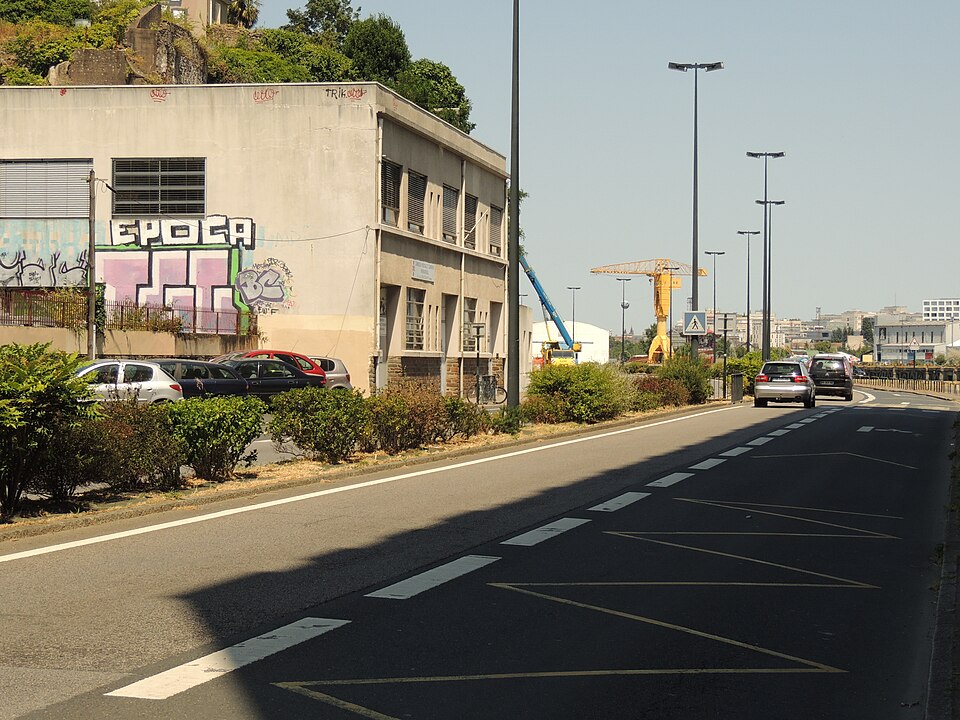



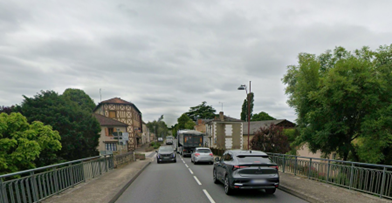
Two successive bridges connect Thouaré-sur-Loire unto Saint-Julien-de-Concelles, constituting a major axis for crossing the Loire to the east of the Nantes agglomeration.
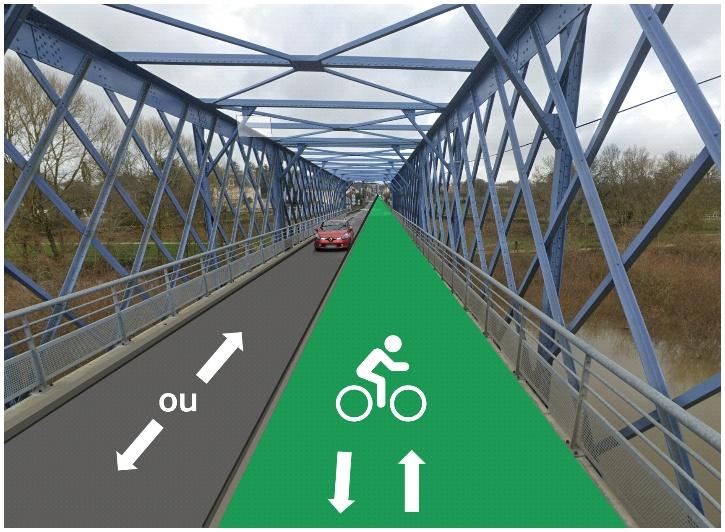
Their narrow size does not currently make it possible to ensure safe traffic conditions for pedestrians and cyclists, hence the desire to Nantes Métropole to examine the feasibility of a partial or alternating one-way to reallocate space for the benefit of soft mobility.
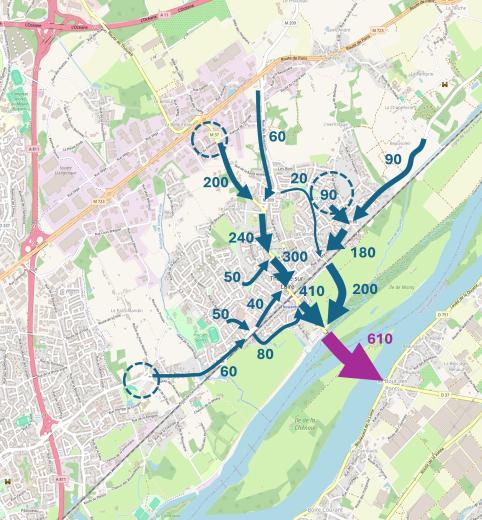
Explain conducted an opportunity study divided into several parts:
The study made it possible to identify the most balanced configurations between maintaining car functionality and securing pedestrian and cycling trips, while integrating the future metropolitan mobility strategy.
The main objective of the mission was to determine the feasibility and relevance of a partial or temporal one-way passage on the bridges of Thouaré, in a logic of shared requalification.
Explain aimed to:
Thanks to a combining approach modeling, analysis and benchmark, Nantes Métropole now has a complete vision of the effects and constraints of each scenario.The study made it possible to objectify political decisions by providing a reasoned reading of the costs, benefits and impacts on traffic.EXPLAIN thus allowed the Metropolis to prioritize the most balanced options, reconciling car accessibility and securing gentle crossings, in a long-term perspective.
This mission illustrates the ability toExplain to mobilize its expertise in multimodal modeling and traffic engineering to respond to complex problems of sharing space.The study conducted on the bridges of Thouaré constitutes a concrete example of integrated planning, where data, simulation and technical consultation combine to guide public decisions towards safer and sustainable mobility.







%20(1).webp)